
Terrazzo Stair Treads
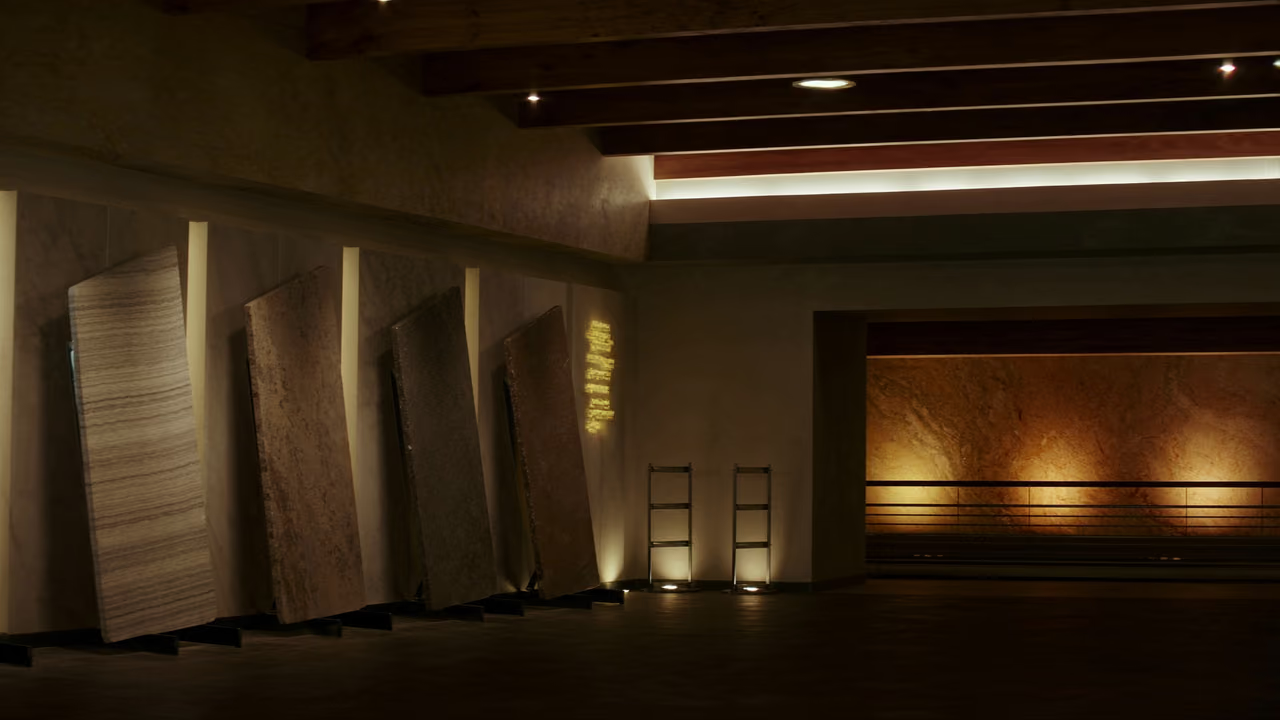

Travertine Pattern Slab Step Terrazzo Stair Tread
View Material →
Wasch Concrete Slab Step Terrazzo Stair Tread
View Material →
Belt Sandblasting L Step Terrazzo Stair Tread
View Material →
Rotating Plate Step Terrazzo Stair Tread
View Material →
L Step with Non-Slip Double Strip Rubber Terrazzo Stair Tread
View Material →
Non-Slip Wide Rubber L Step Terrazzo Stair Tread
View Material →
L Step with Non-Slip Single Strip Rubber Terrazzo Stair Tread
View Material →
L Type Step Terrazzo Stair Tread
View Material →
Plate Type Step Terrazzo Stair Tread
View Material →B2B Procurement and Technical Guide for Natural Stone Treads
Sourcing Tread: B2B Guide
Procuring high-quality natural stone treads requires a strict focus on material density, slip resistance, and dimensional accuracy. For large-scale architectural projects, the tread serves as a critical structural and aesthetic component. Efesus Stone manufactures these elements using premium Turkish marble and travertine, ensuring that each unit meets the load-bearing requirements of commercial and residential staircases. Unlike standard tiles, a tread must withstand concentrated foot traffic and edge impact, making material selection and finish type paramount for long-term performance.
Technical Specifications and Selections
Our production facility utilizes precision CNC machinery to achieve exact tolerances for various staircase configurations. For high-traffic exterior or public areas, we recommend the Belt Sandblasting L Step, which provides a textured surface to maximize friction. For projects requiring enhanced safety protocols, the L Step with Non-Slip Double Strip Rubber incorporates mechanical inserts to prevent hydroplaning in wet conditions.
Standard thickness for natural stone treads typically ranges from 2cm to 3cm, with custom 4cm profiles available for cantilevered designs. We offer several edge profiles, including bullnose, chamfered, and birdsmouth joints for the L Type Step. Surface finishes include honed, polished, and sandblasted, depending on the required Slip Resistance Value (SRV). Understanding the mechanical properties of the stone is essential; for instance, analyzing What is travertine, what are its features and where is it used? can help procurement managers decide if a porous stone is suitable for specific environmental exposures.
Maintenance and Sourcing Advantages
Maintaining the integrity of stone treads involves regular pH-neutral cleaning and periodic sealing to prevent deep-seated staining. For commercial applications, we advise a high-grade impregnating sealer to protect the stone without altering the friction coefficient. Sourcing from Efesus Stone ensures supply chain stability, as we manage the process from our own production lines to global logistics. Our quality control team inspects each batch for color consistency and structural soundness, ensuring that bulk orders for multi-story developments remain uniform in appearance and technical performance.
Frequently Asked Questions

Supply Notes
Sizing, finishing and selection support.
Custom sizes
Coordinate availability, production details and documentation with the Efesus Stone team.
Project finishes
Coordinate availability, production details and documentation with the Efesus Stone team.
Export packing
Coordinate availability, production details and documentation with the Efesus Stone team.